Let me just say it: protein’s publicist deserves a raise.
We are having a real moment with protein-infused everything. I knew we had gone off the amino chains—that’s a protein joke—when I saw Protein Pop-Tarts.
C’mon, man.
And then water started feeling left out of the party.
I hesitate to really roll my eyes and climb onto my soapbox about this movement because protein is important. Oh, so important, actually.
It’s called a building block for a reason. Protein helps build and repair muscle, but it’s also involved in the structure and function of cells throughout our bodies, as well as enzymes and hormones.
You literally can’t live without the stuff.
And when faced with the decision in the Pop-Tart aisle between regular fudge and PROTEIN FUDGE, sure, I’d probably push you toward the enhanced fudge.
If we must Pop-Tart, let it be Protein Pop-Tart!
But if protein fudge starts becoming a staple food—or one of your main sources of protein—that’s where I start raising an eyebrow. Adding protein to a highly processed food doesn’t automatically give it a health halo. You still need to look at the whole food and what else comes along for the ride.
As I’m sure we all do, I have a favorite nutrition researcher.
No? Just me?
I regularly follow the ZOE Science & Nutrition podcast; the team has a wonderful way of breaking nutrition research down into something my non-scientist brain can understand. In this episode, they bring on Stanford nutrition researcher Christopher Gardner to talk about protein.
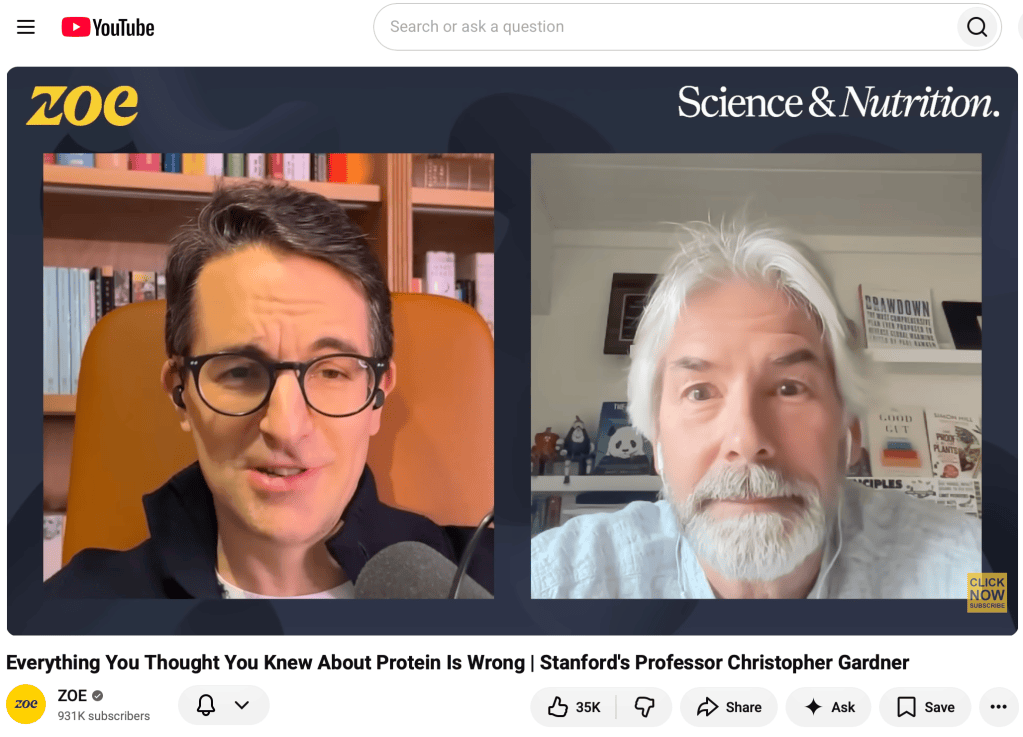
And because we are clearly having A Protein Moment, I wanted to know:
Do we actually need all this protein—or have we just been marketed into thinking we do?
Here are six takeaways from Gardner that I think are worth talking about.
1. Protein is incredibly important—but “important” doesn’t mean “more is better.”
Of course we need protein. But somewhere along the way, we seem to have confused “enough” with “as much as humanly possible.”
Protein provides structural material for our cells and tissues and is involved in enzymes, hormones and many other functions. The protein we eat gets broken down into amino acids, which our bodies then use as building blocks.
My take: Obviously this is important. But when we fixate on one particular element of nutrition, we stop paying attention to all the other incredibly important things our bodies need.
I’m always looking at you, fiber.
You get linked to farts and suddenly nobody wants to talk about you anymore. (I see another important blog post coming.)
2. The recommended amount of protein isn’t a minimum everyone needs to beat.
Here’s something I didn’t realize.
The Recommended Dietary Allowance for protein—0.8 grams per kilogram of body weight per day—was designed to cover the needs of nearly all healthy people in the population. It isn’t a starting line we’re all supposed to race past.
And yet we hear that number and think: Well, if THAT’S good, MORE must be better!
My take: This is where things get surprisingly controversial among scientists who forget that average people aren’t counting macros and generally don’t know how many kilograms they weigh.
(Remember: Americans will use elephants, fruits and football stadiums instead of the metric system of measurement.)
If you’re here with me on this health and wellness journey, I’m guessing you also don’t know exactly how many grams of protein were in your breakfast.
What may come as a relief is that Gardner argues many of us are already getting plenty of protein through ordinary food—without having to supplement everything we eat with extra protein.
Phew.
Put down the protein Pop-Tart.
Or don’t. We’ll get back to that.
3. Even people who exercise may already be getting plenty.
Gardner acknowledges that someone actively trying to build muscle may need more protein than someone simply maintaining tissue.
But here’s his larger point: active people also tend to eat more food.
More food = more protein.
He discusses recommendations that can reach around 1.6 grams per kilogram for athletes, while arguing that many active people may already be getting much more protein through their diets than they realize—without adding shakes and bars.
My take: This one is tough for me.
As a runner, I want to make darn sure my muscles have what they need to perform, recover and grow.
And I really hate the taste of protein powders.
I’ve always been of the mindset that I can get what I need naturally, but as someone who very rarely eats meat, I’ve wondered:
Can I really get enough without supplements?
Going back through my own meal tracking, I was surprised by just how much protein I was already getting from plants.
Which leads very nicely to…
4. Plants contain all 20 amino acids.
Without getting too far into the science of chains and reactions—because my brain literally CAN. NOT. COMPUTE.—here’s the important part:
The amino acids your body needs can all be found in plant foods.
This is big for those of us who eat little or no meat.
Gardner explains that plant foods aren’t “missing” essential amino acids. The proportions differ. Grains, for example, are lower in lysine, while legumes are lower in some sulfur-containing amino acids.
But eating enough food and a varied diet can provide the amino acids your body needs entirely from plants.
My take: I love varying my plants.
I make a game out of seeing how many different ingredients I can squeeze into a meal. Different plants bring different combinations of protein, fiber, vitamins, minerals and other beneficial elements to the party.
And if there’s one nutritional party I’m interested in attending, it’s one where everybody brings something.
5. Don’t judge a protein food by protein alone.
Look at what comes along for the ride.
When comparing protein sources, protein content isn’t the only thing that matters.
Beans, lentils, tofu and whole grains don’t just provide protein. They can also bring fiber and other nutrients along with them.
That’s why when Gardner is asked for a healthy source of protein, his answer is basically:
Beans.
My take: oh boy, do I love beans.
I grew up eating refried beans made by my Latina granny. I don’t understand a life without beans.
Fortunately, there are approximately eight bazillion ways to eat them.
Mark recently started making a simple bowl with black beans, quinoa, scrambled eggs, avocado and a scoop of cottage cheese that I have decided must be my dinner every night for the rest of my life.
Unfortunately, he is still new to the bean life, so I don’t think we’ll be able to maintain this aggressive bowl schedule.
But we do regularly rotate through protein-and-fiber-packed favorites including chickpeas, beans, quinoa, farro and oats.
And that brings us right back to my poor, underappreciated friend:
Fiber.
Protein gets the publicist. Fiber gets the fart jokes.
Justice for fiber.
6. “High protein” is a marketing claim, not a health halo.
This might be the biggest takeaway of the entire episode for me.
Gardner is skeptical that most people need protein shakes and bars when compared with simply eating whole foods, and he challenges the assumption that adding protein automatically makes something healthier.
My take: I share his concern—but I also don’t want us turning this into another all-or-nothing nutrition rule.
If you’re running out the door and the only realistic breakfast available is a Pop-Tart, have the Protein Pop-Tart.
Then, when life settles down enough for you to put together a meal with beans, lentils, quinoa, eggs, meat, tofu or whatever protein sources you enjoy, do that.
One imperfect meal isn’t the problem.
The bigger question is what your overall pattern looks like.
The Bottom Line
Wellness does not need another complicated rule that requires a calculator.
Protein matters.
So do fiber, healthy fats, carbohydrates, vitamins, minerals and the thousands of compounds we get from eating a variety of whole foods.
You don’t have to turn every meal into a math equation.
Eat a varied diet. Prioritize real food when you can.
And stop obsessing.
You can watch the full conversation with Christopher Gardner on ZOE Science & Nutrition HERE.
I help busy women answer their protein—and plenty of other wellness—questions without making healthy living another full-time job.
If you’re overwhelmed by all the conflicting nutrition advice and aren’t sure where to start, set up a free 30-minute call with me.
We’ll talk about where you are, where you want to go and one simple first step to get you moving in the right direction.








Leave a comment